Linear to quadratic and back - the entire flow
Also introduce the terms - roots and zeroes
Linear relationships and equations
General equation and the shape of the graph
A linear relationship between two quantities can be expressed in the form y = mx + b, where m is the slope and b is the y-intercept; or in the form Ax + By + C = 0, where A, B, and C are constants.
The graph of a linear relationship is a straight line
General Equation and Graph
A linear relationship between two quantities can be written as
y = mx + c,
where m is the slope and c is the y-intercept. It can also be written in standard form as
Ax + By + C = 0,
where A, B, and C are constants. The graph of a linear relationship is a straight line.
Plotting a Linear Graph
To plot the graph of a linear relationship:
- Substitute several values of x into the equation to calculate the corresponding values of y.
- Plot the resulting points (x, y) on a coordinate plane.
- Join the points with a straight line.
The intercepts are also useful:
- The x-intercept occurs when y = 0. For y = mx + c, solve mx + c = 0.
- The y-intercept occurs when x = 0. Substituting x = 0 into y = mx + c gives y = c, so the point is (0, c).
Thus, the graph of the relationship y = mx + c crosses the x-axis at the solution of the equation mx + c = 0 and crosses the y-axis at (0, c).
Finding the Slope
The slope indicates the steepness and direction of a line:
- m > 0: the line rises from left to right.
- m < 0: the line falls from left to right.
- m = 0: the line is horizontal.
- A vertical line has an undefined slope.
From a Graph
Choose two points on the line and calculate rise over run, including the signs of both changes.
From an Equation
Rearrange Ax + By + C = 0 into the form y = mx + c:
y = -\frac{A}{B}x - \frac{C}{B}.
Therefore, the slope is
m = -\frac{A}{B}.
From Two Points
For the points (x_1, y_1) and (x_2, y_2), the slope is
m = \frac{y_2 - y_1}{x_2 - x_1}, \qquad x_1 \ne x_2.
Finding the Equation from Two Points
Given two points:
- Calculate the slope using m = \frac{y_2 - y_1}{x_2 - x_1}.
- Substitute either point into y = mx + c and solve for c.
- Write the equation of the line as y = mx + c.
Alternatively, substitute both points into y = mx + c to form
y_1 = mx_1 + c, \qquad y_2 = mx_2 + c,
and solve the simultaneous equations for m and c.
Solving Two Simultaneous Linear Equations
For equations in the form Ax + By + C = 0, use substitution or elimination.
If one equation is already in the form y = mx + c, substitute this expression for y into the other equation.
For two equations in slope-intercept form,
y = m_1x + c_1, \qquad y = m_2x + c_2,
the point of intersection satisfies both equations. Therefore,
m_1x + c_1 = m_2x + c_2.
If m_1 \ne m_2, the x-coordinate of the intersection is
x = \frac{c_2 - c_1}{m_1 - m_2}.
Cases for the Number of Solutions
- If m_1 \ne m_2, the lines meet at exactly one point.
- If m_1 = m_2 and c_1 \ne c_2, the lines are parallel and there is no solution.
- If m_1 = m_2 and c_1 = c_2, the lines are identical and there are infinitely many solutions.
- If c_1 = c_2 and m_1 \ne m_2, the intersection is on the y-axis at (0, c_1).
Quadratic Relationships and Equations
General Equation and Graph
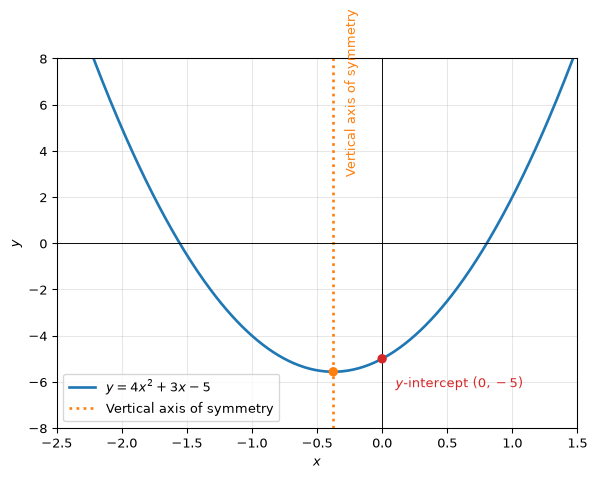
The general form of a quadratic relationship is
y = ax^2 + bx + c, \qquad a \ne 0.
Its graph is a parabola:
- If a > 0, the parabola opens upwards and has a minimum point.
- If a < 0, the parabola opens downwards and has a maximum point.
- The parabola is symmetric about a vertical line through its vertex.
- When x = 0, y = c, so the y-intercept is (0, c).
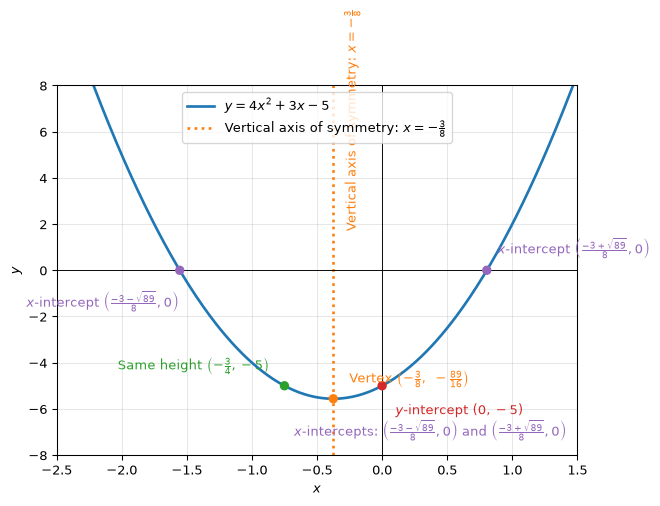
To find another point with the same y-coordinate as the y-intercept, set y = c:
ax^2 + bx + c = c \quad\Longrightarrow\quad x(ax + b) = 0.
Thus, x = 0 or x = -\frac{b}{a}. These points are symmetric about the axis of symmetry, so the axis has equation
x = -\frac{b}{2a}.
This is also the x-coordinate of the vertex. Substituting it into the quadratic gives the vertex
\left(-\frac{b}{2a},\, \frac{4ac - b^2}{4a}\right).
The x-intercepts are found by setting y = 0:
ax^2 + bx + c = 0.
The solutions of this quadratic equation are the x-coordinates where the parabola crosses the x-axis. Once these solutions, the vertex, and the y-intercept are known, the graph can be sketched.
Solving a Quadratic Equation by Completing the Square
Start with
ax^2 + bx + c = 0, \qquad a \ne 0.
- Divide by a: x^2 + \frac{b}{a}x + \frac{c}{a} = 0.
- Rearrange the constant term: x^2 + \frac{b}{a}x = -\frac{c}{a}.
- Add \left(\frac{b}{2a}\right)^2 to both sides: x^2 + \frac{b}{a}x + \left(\frac{b}{2a}\right)^2 = \left(\frac{b}{2a}\right)^2 - \frac{c}{a}.
- Write the left-hand side as a square and simplify the right-hand side: \left(x + \frac{b}{2a}\right)^2 = \frac{b^2 - 4ac}{4a^2}.
- Take the square root of both sides: x + \frac{b}{2a} = \pm\frac{\sqrt{b^2 - 4ac}}{2a}.
- Solve for x: \boxed{x = \frac{-b \pm \sqrt{b^2 - 4ac}}{2a}}.
Nature of the solutions to the quadratic equation
The above value of x is the x-coordinate of the points where the graph crosses the x-axis. What are the possible values this can take and what does it mean for the graph or the equation?
Solving a Quadratic Curve and a Line
Consider the quadratic curve
y = ax^2 + bx + c_1
and the line
y = mx + c_2.
At a point of intersection, both equations have the same y-value. Equating them gives
ax^2 + bx + c_1 = mx + c_2.
Rearranging gives the quadratic equation
ax^2 + (b - m)x + (c_1 - c_2) = 0.
The solutions of this equation are the x-coordinates of the intersection points. The corresponding y-coordinates can then be found by substituting each x-value into either original equation.